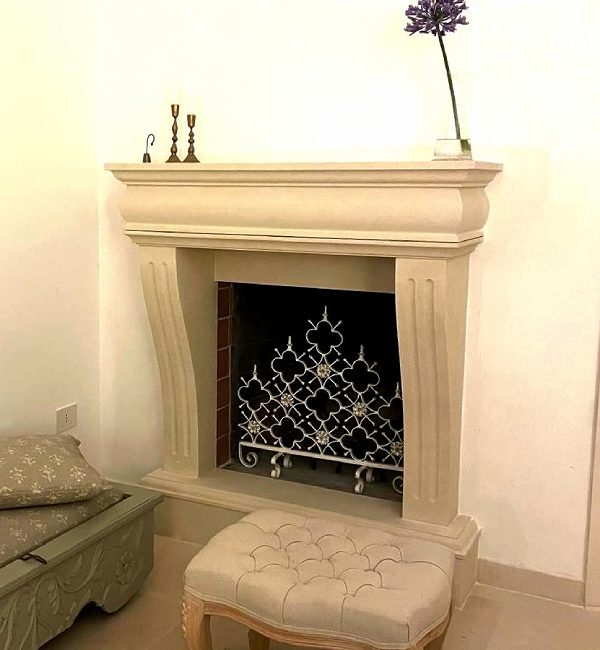


Camini in pietra
La pietra e il fuoco
La pietra, il fuoco, la casa.
Il camino è il punto dove ci si raccoglie e ci si scalda. Per questo lo tratto come un’architettura e non come un semplice arredo: la pietra che accoglie il fuoco deve stare in piedi, durare, e crescere insieme al muro che la ospita.
Quando comincio non parto dal disegno, parto dalla stanza: osservo le sue dimensioni, l’ambiente, lo stile. Poi decido le misure. È la misura che fa stare bene un pezzo dentro una casa.
Un camino si costruisce due volte. La prima in cartone, a grandezza naturale: lo monto sul posto e verifico che tutto torni — la bocca, la mensola, l’ingombro, l’altezza da terra. La seconda in pietra: blocchi separati, scolpiti a mano, cornici e modanature una per una, poi montati. L’acciaio che lo tiene al muro resta affogato dentro la pietra. Del fissaggio non si vede niente: a vista resta la pietra.
EN
The stone, the fire, the house.
The fireplace is the point where one gathers and warms oneself. For this I treat it as architecture and not as a simple furnishing: the stone that receives the fire must stand, last, and grow together with the wall that hosts it.
When I begin I do not start from the drawing, I start from the room: I observe its dimensions, the environment, the style. Then I decide the measurements. It is the measure that makes a piece sit well inside a house.
A fireplace is built twice. The first in cardboard, at full size: I mount it on site and verify that everything adds up — the mouth, the shelf, the overall dimensions, the height from the ground. The second in stone: separate blocks, carved by hand, frames and mouldings one by one, then mounted. The steel that holds it to the wall stays embedded inside the stone. Of the fixing nothing is visible: in view remains the stone.